Eugene de Blaas (1843–1931) was an Austrian-Italian artist who specialized in painting the everyday life of the Venetian people. Typical works in his oeuvre carry titles like The Love Letter, The Flower Seller, and Flirtation. He painted these easily accessible themes with a colorful palette and a highly polished technique, creating an immediate appeal to his international clientele. Looking at his oeuvre, it is clear that De Blaas preferred to immortalize the happier and lighter moments of Venetian life on the canvas. An overview of all his works can be found in our book Eugene de Blaas – The Complete Works.
While many parts of Europe and the United States witnessed the impact of the Industrial Revolution, De Blaas lived in Venice, a unique bubble where factories and machines did not yet replace ancient crafts and beautifully dressed people. Venice was known for its rich history and architectural beauty and was popular among international visitors on The Grand Tour. But whereas many of De Blaas’ Venetian colleagues focused on capturing the architectural beauty and unique atmospheric conditions of Venice in their artworks, De Blaas preferred to immortalize the daily life of the Venetians. This subject proved popular among many people abroad as a somewhat nostalgic reminder of either their time in Venice or, more generally, an idyllic time before the impact of the Industrial Revolution.
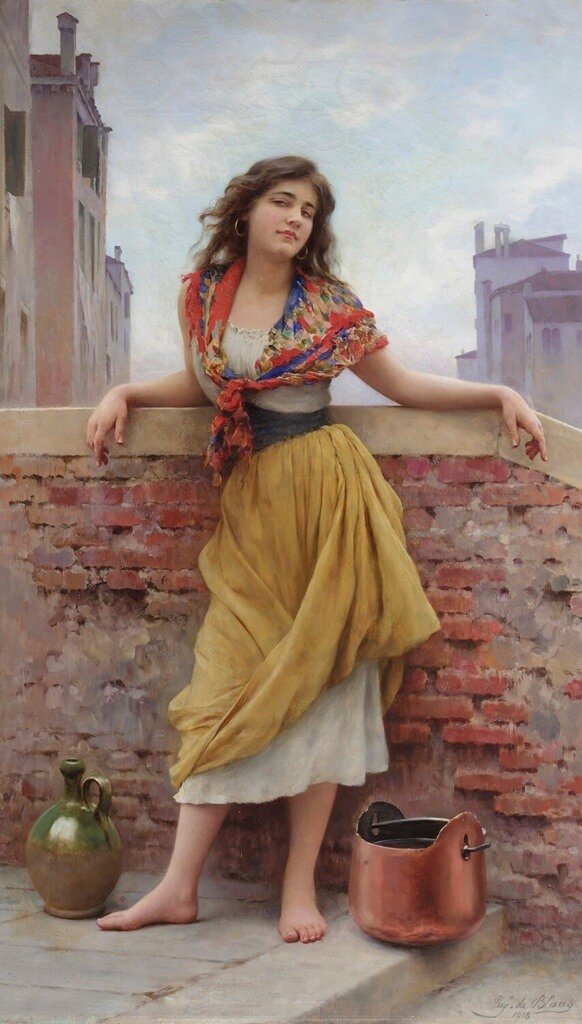
The Water Carrier (1908) by Eugene de Blaas
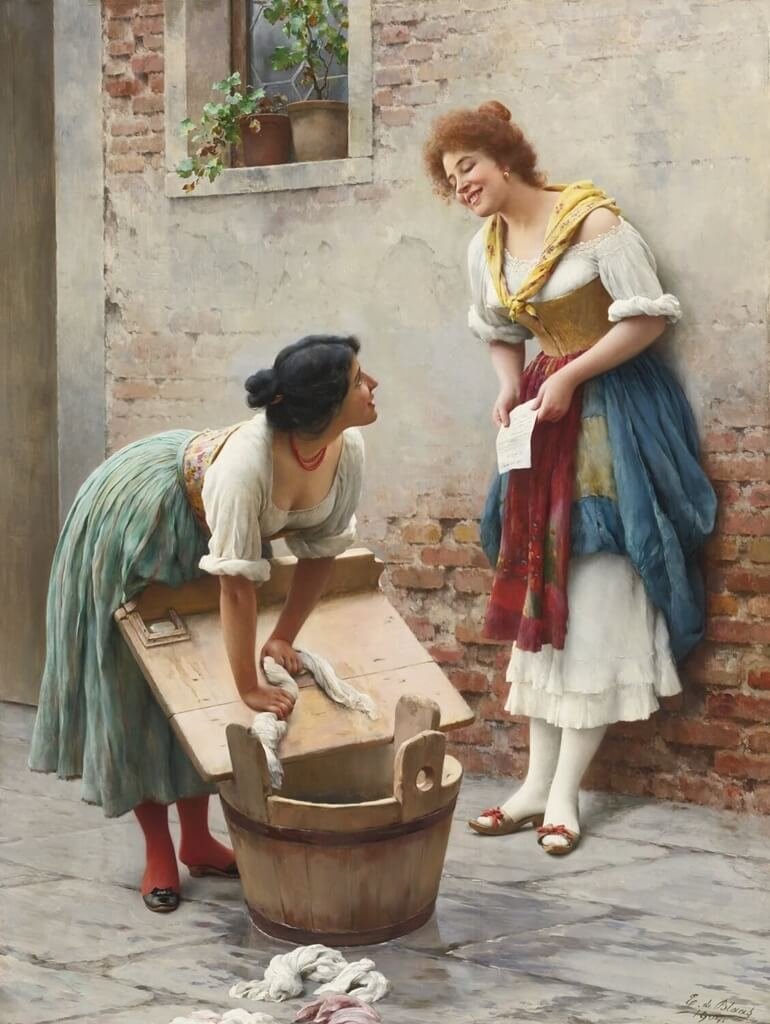
Sharing the News (1904) by Eugene de Blaas
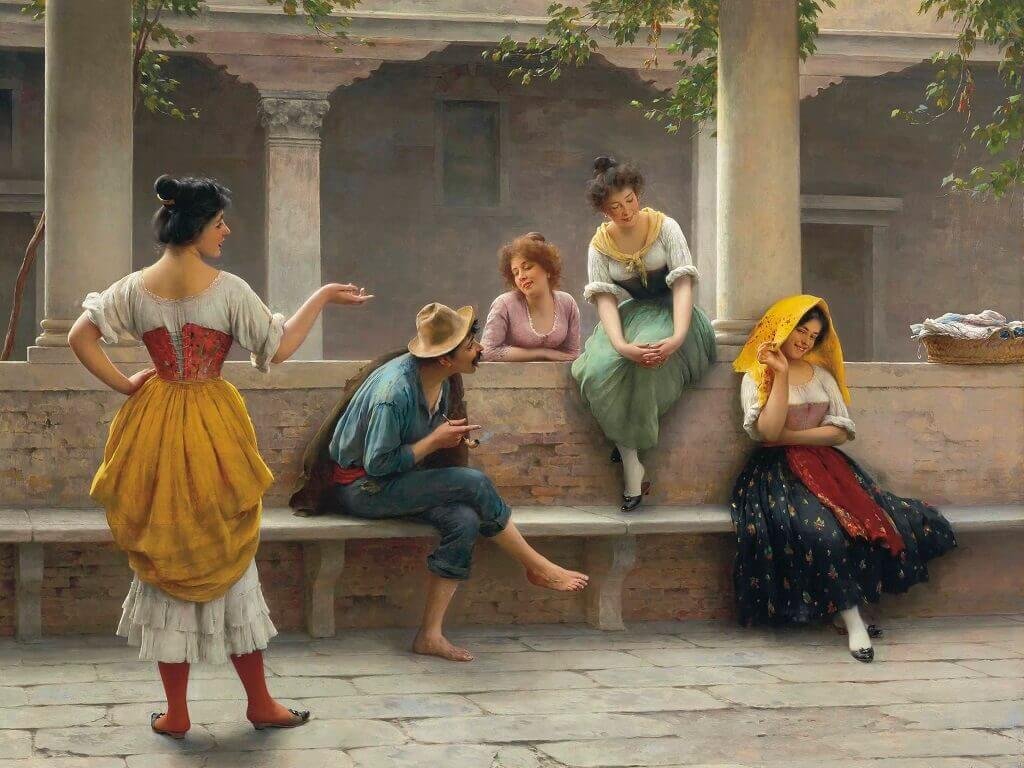
Gossip (1903) by Eugene de Blaas
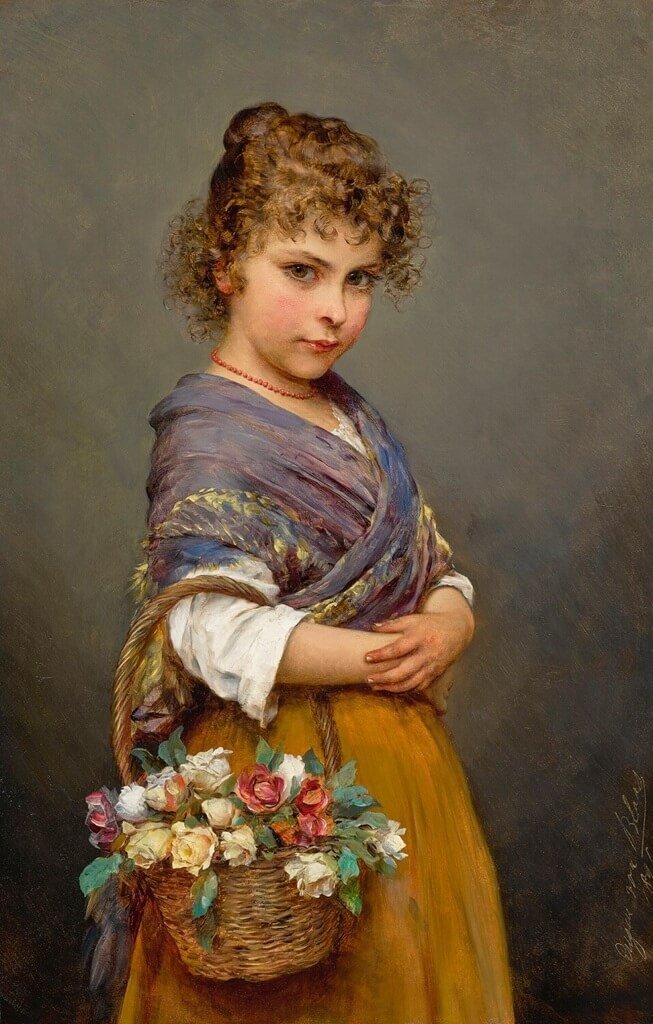
Young Girl with a Basket of Flowers (1894) by Eugene de Blaas
De Blaas painted a variety of scenes, ranging from dynamic group paintings to portraits to paintings with children. Still, the central theme throughout his career was the beauty of young Venetian women, often dressed in colorful and elegant outfits. While their beauty is somewhat idealized, De Blaas’ works also contain a great degree of realism, as confirmed by comparing his works to those of other artists and even to contemporary Venetians. The women in De Blaas’ paintings are engaged in all sorts of daily activities, like flirting, gossiping, selling flowers, washing, etc. De Blaas was particularly adept at capturing their body language, which he used to create intriguing narratives.
His titles and compositions provide the general frame for the narrative, but he leaves it to the viewer to complete the story based on the facial expressions and body language of the main characters. These clues range from a hand on their hip to a blush on their cheeks to a longing gaze. In addition, De Blaas painted many portraits of these women, usually not official portraits, but anonymous ones focusing on their beauty instead of the activities they were involved in. These portraits were both attractive artworks for collectors and also served as great practice to capture the beauty of the Venetians in his paintings involving a narrative.