Carl Johann Spielter was born on February 1, 1851, in Bremen, a city in northwestern Germany. He grew up in Bremen, and by the time he was 20, he had completed a commercial apprenticeship in his hometown. In 1871, he continued his commercial training in Liverpool and Birmingham, England. However, by 1876, Spielter would end his commercial career to start training as an artist in Munich. He first studied at the Royal School of Arts and Crafts under Ferdinand Barth. After that, he was accepted at the Royal Academy in Munich, where he would study with artists like Gyula Benczúr (1844 – 1920), Otto Seitz (1846 – 1912), and Gabriel von Max (1840 – 1915). In 1879, he would publicly exhibit his first work, and he finished his studies the year after. After a trip to Capri in 1880, he would move to Vienna, Austria, to become a master student under Hans Makart (1840 – 1884) at the Academy of Fine Arts.
During the 1880s, he experimented with various genres and developed his artistic vision as an independent artist. Spielter was slowly making a name for himself, able to sell his work and receive various commissions. In 1889, he married Veronika Gavenda, and two years later the couple moved to Charlottenburg, just outside of Berlin, Germany. At this moment, he was mostly a painter of portraits and genre scenes.
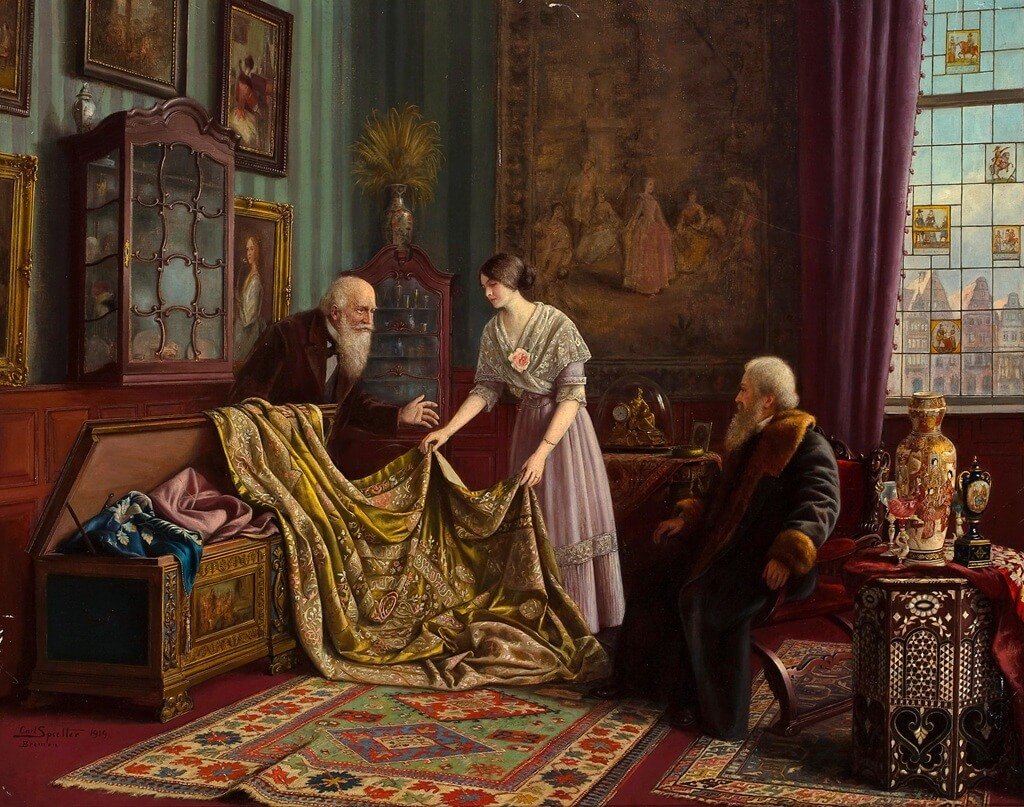
At the Antique Dealer's Shop (1919) by Carl Johann Spielter
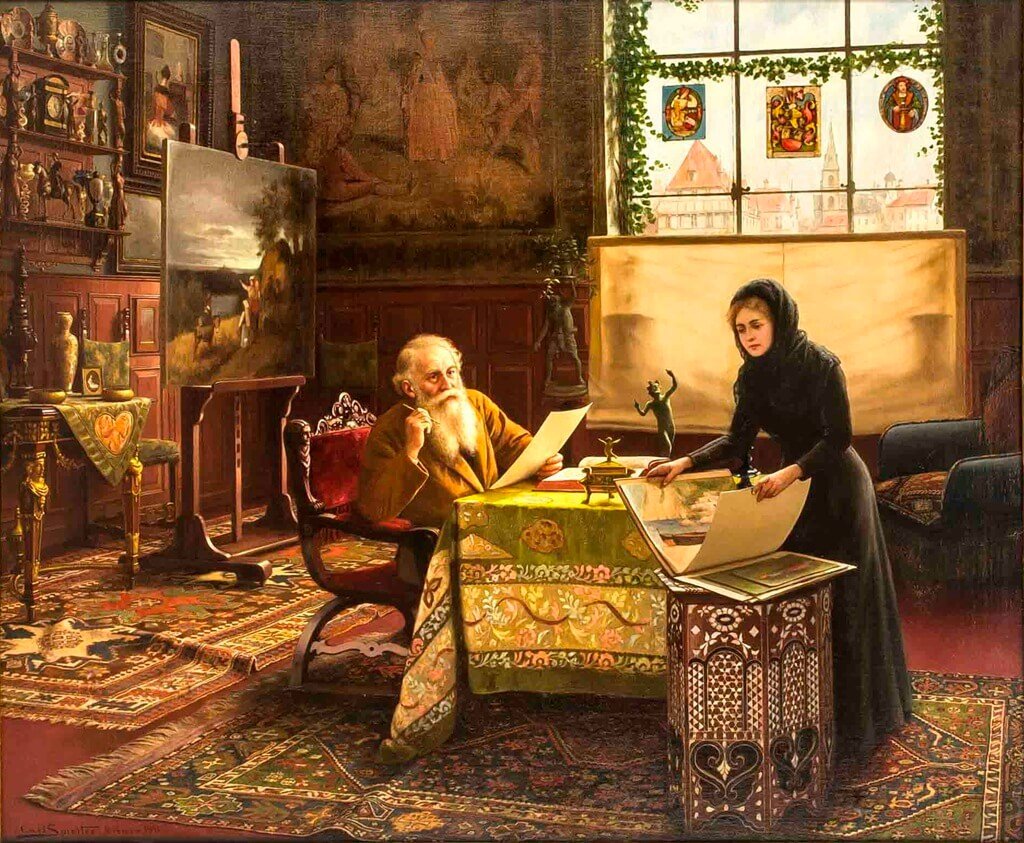
The Painter in the Studio (1911) by Carl Johann Spielter
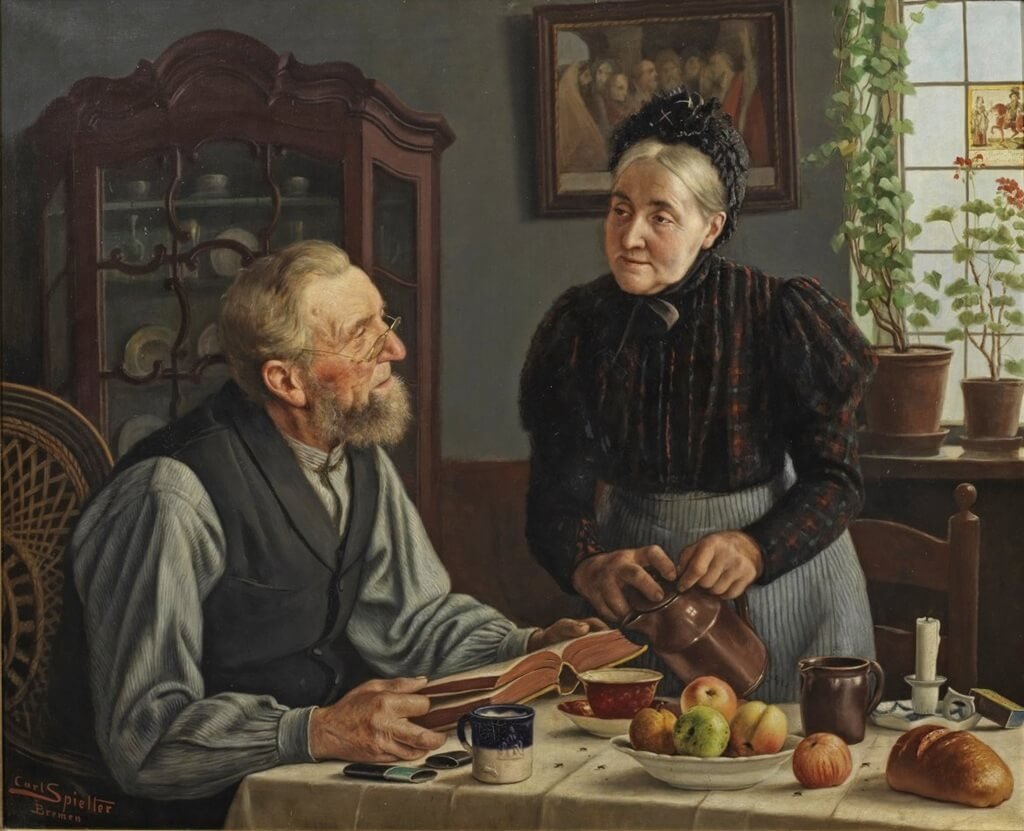
Older Farmer Couple Having Coffee in a Parlor (undated) by Carl Johann Spielter
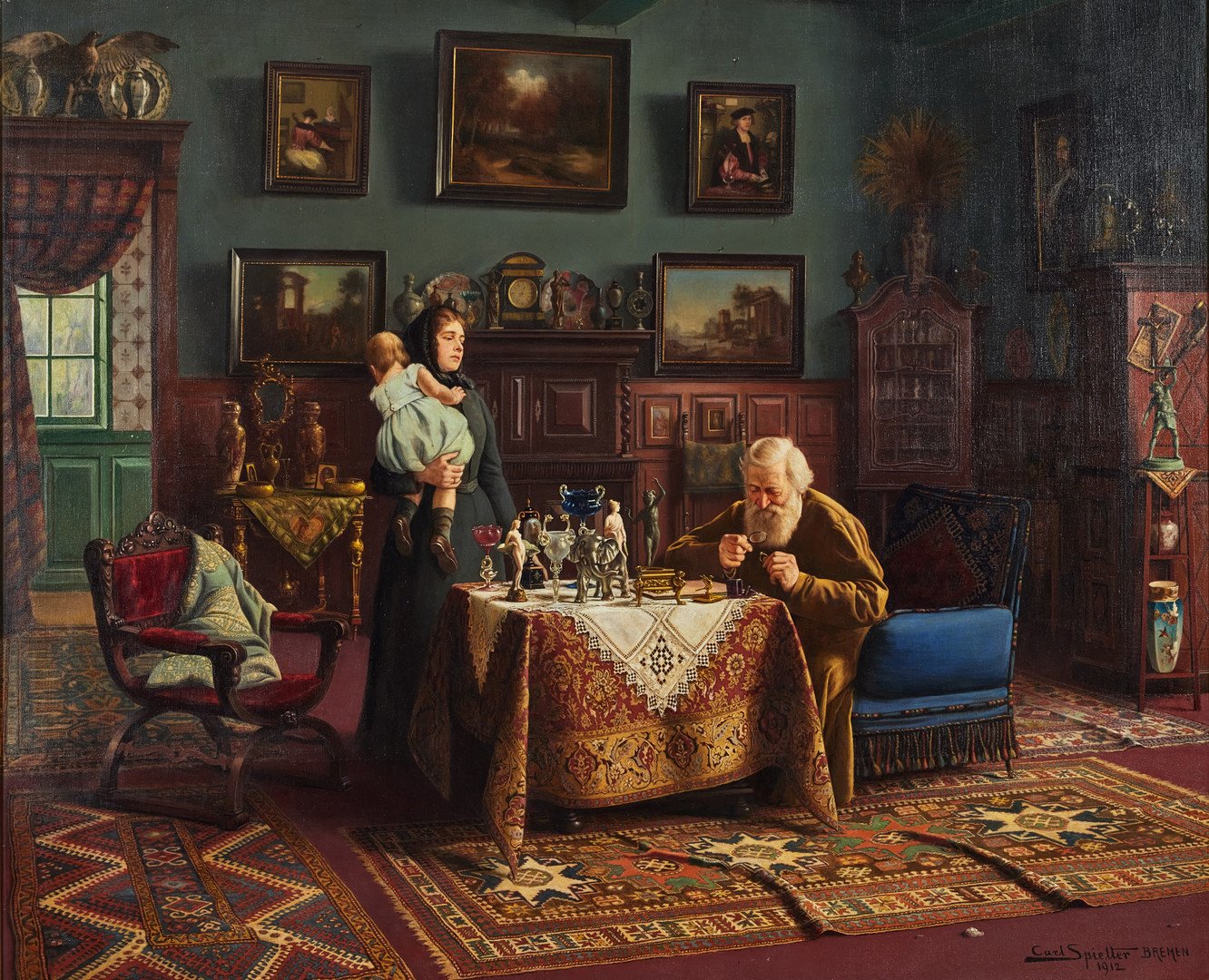
The Antique Dealer (1912) by Carl Johann Spielter
Spielter painted in a realistic style with great attention to detail, especially when reproducing a variety of objects and materials. Many of his works are intimate portrayals of daily life with sentimental human themes. These works evoke a sense of nostalgia, although the events portrayed reflect emotional dynamics often associated with a life-altering event, such as the death of a family member. Spielter carefully developed the human characters in his scenes, paying attention to their facial expressions and body language to create a narrative. Throughout his oeuvre, some scenes recur many times with relatively small variations, probably because his works were popular and repetitive themes were an efficient way to satisfy his clientele.
Today, Spielter is best known for his narrative interior scenes of everyday life. In particular, he frequently painted three main types of interior scenes: those related to the antique business, elderly couples at home, and the artist in his studio. Many of these interiors are relatively dark, with targeted, subtle lighting to highlight people and key objects.
In 1893, Spielter returned to his hometown of Bremen, where he would live the remainder of his life. By now, he was a successful artist who made a very good living from his art. However, by the end of the 19th century, the art world was being revolutionized by several modern art movements that were gaining popularity. Collectors and museums in Bremen started to embrace these modern art movements, and Spielter’s popularity in his hometown quickly waned. However, through various dealers, he was still able to successfully sell his work in other parts of Germany and abroad. In 1904, he spent several months with his brother in New York, and he would be able to sell some works in the American market in later years. Spielter would continue to paint until 1922, when he died in his hometown.